
Imagine being at a buffet with endless options—you’re tempted to try everything but eventually realize you’re most drawn to a few dishes that truly excite your taste buds. That’s what finding your niche feels like. It’s as if every genre, every style, every opportunity calls your name. You love a bit of everything—weddings, portraits, landscapes, fashion. But deep down, a small voice might be asking: Should I focus on just one thing?
If you’ve ever been caught in this dilemma, you’re not alone. I’ve been there too. The fear of narrowing down feels real. What if you get bored? What if you miss out something? And yet, defining your niche can sometimes feel like the clarity you never knew you needed. Let’s explore both sides of this question and take a closer look at my own photography journey to help you navigate yours.
The Case for Defining Your Niche
For many creatives, defining a niche can feel like taking a risk. But it’s a risk worth considering. Here’s why:
- Clarity and Direction: When you focus on one area, you stop feeling scattered and start building a clear identity.
- Mastery Over Your Craft: Specializing in a niche allows you to dive deeper and refine your skills.
- Building the Right Audience: Your work begins to resonate more with the right people—those who genuinely connect with what you create.
Defining a niche doesn’t mean you’re giving up on exploration—it means you’re choosing to excel in what you love most.
The Beauty of Not Defining a Niche
On the flip side, there’s immense value in being a generalist too. If you’re someone who thrives on variety and finds joy in exploring different genres, that’s a valid choice. Being a generalist helps you:
- Build Versatility: You become adaptable, able to handle any creative challenge that comes your way.
- Discover Hidden Talents: By trying everything, you might stumble upon something unexpected that you love.
- Keep Your Work Exciting: Variety keeps things fresh and prevents burnout.
Not defining a niche (particularly when you have just started your journey), helps you broaden your perspective, expand the learning curve and take an informed decision eventually.
Key Elements of Photography Niche
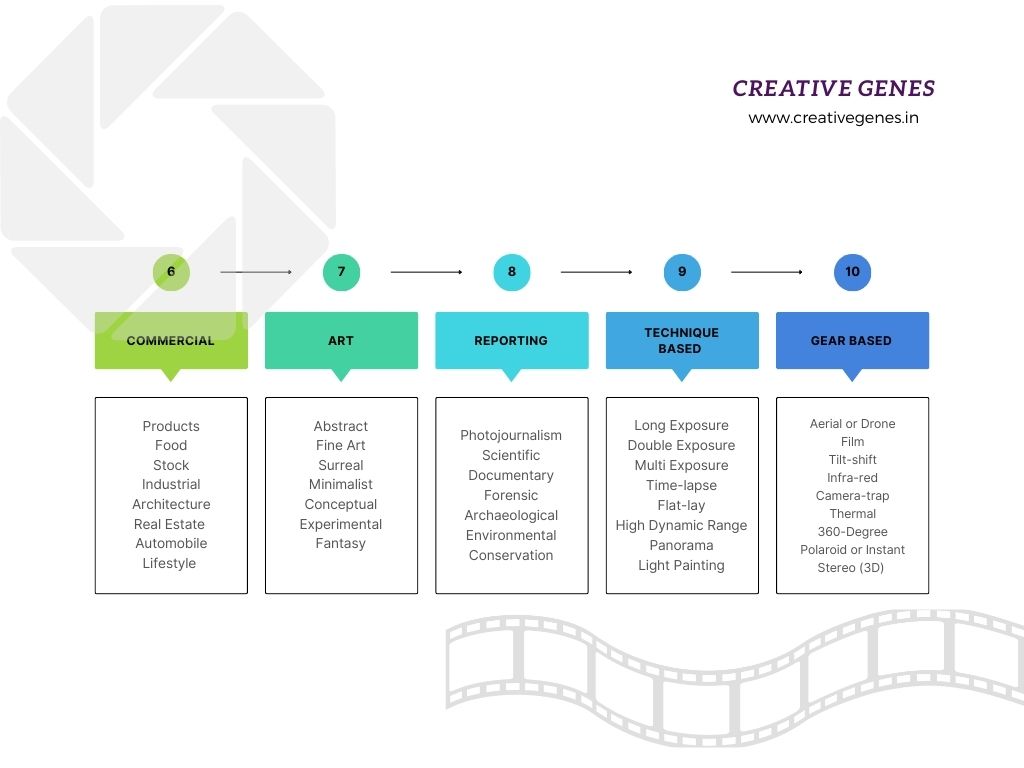
Photography niches can be distilled into 5 key elements: Theme, Subject Matter, Style, Technique, and Use. Let’s explore them briefly:
I. THEME
The theme is the core idea or underlying message behind your body of work. It could reflect your passion for nature, travel, cultural or biological diversity, or even fleeting moments of joy. Your theme should resonate with you, whether it’s bold or subtle.
II. SUBJECT MATTER
This refers to the “what” of your photography under that broader theme—landscapes, portraits, wildlife, architecture, or abstract details. Focus on what excites you most and what you’d love to shoot repeatedly.
III. STYLE
Style defines the visual language of your photos—composition, lighting, and editing, to name a few. It’s the unique look that helps your audience recognize your work from the rest, whether it’s moody, minimalist, or vibrant.
IV. TECHNIQUE
Technique is your individualistic approach to capturing content—digital, film, drones, action camera, or specific methods like long exposure, shooting from the hip, etc. While you can explore multiple techniques, specializing gives your niche clarity.
V. USE
This is about how your work is finally consumed—fine art prints, editorial spreads, commercial campaigns, or social media. Defining the end-use helps shape your photography’s purpose and market.
The definition of NICHE has turned out to be an organizational trap, especially with the enormous democratization of photography. It tries to fit photographers into predefined categories, even though many great photographers never saw their work defined with that word. The true purpose was always to give photography autonomy as a form of artistic expression. Defining a niche can be harmful since it limits, confines and grants a utilitarian function to photography—something that is not the objective of art, but has always been the final objective of a profession.
– Remon Diaz
Don’t Miss This Read!

Range
by David Epstein
David Epstein’s book shows that success stems from exploring diverse experiences and balancing interests. Through stories of top athletes, artists, and scientists, he proves generalists often outperform specialists in many fields.
My Take: It is a pro-generalist book, so you need to read it with a grain of salt.
What You Can Do Next
If you’re set on creating your own niche, here are a few steps to guide you.
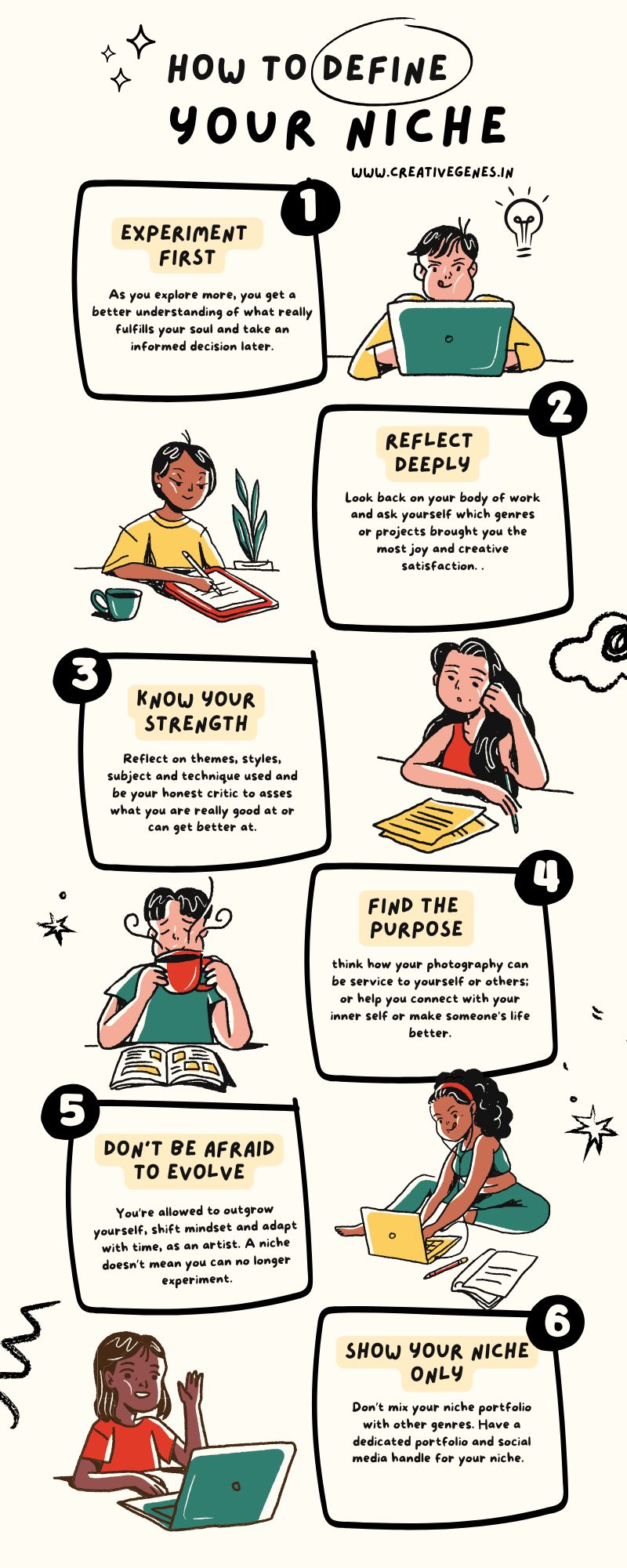
Step 1: Experiment First
Don’t rush to choose a niche. Explore freely and give yourself time to discover what you truly love. You can start with trying to focus on one genre for a set period to see how it feels. You can always adjust later.
My Struggles of Doing It All
When I first started out over a decade back in Kolkata, I wanted to try everything. I started my journey with nature then a bit of travel and college events. A few years later when I had a chance to cover a friend’s wedding in Bangalore, I took up wedding photography seriously and created a good business for myself in the three years that I spent in Bangalore.
Experimenting from Studio Lights to Street Life
Moving to Mumbai, the city of Bollywood movies, fashion and glamour, I tried to dabble in fashion and product photography, to expand my horizon and particularly to learn studio lighting which was a completely unknown territory. Travelling to places from Kashmir to Krabi got my heart into landscape photography. Fast forward to the year 2024, I developed keen interest in street photography. Weddings, fashion, products, landscapes—it all felt like a creative playground. Each genre came with its own excitement, its own challenges, offering something to learn. I’ll admit, there’s something thrilling about being a generalist. You never know what project might come next, and you’re constantly learning new skills.
Moral of the Story
The moral of the story – you never know what is your niche, until you try and experiment with wide array of genres. For how long? That is another question which only your intuition and on-the-go experiences can guide you. The idea is never to stop experimenting and challenging yourself. For those of you who are still figuring it all out, I want you to know this: There’s nothing wrong with being in that phase. It is not a race, but a journey, which every artist has to take on its own to find the answers. Moreover, everything adds to your learning. Had I not been a generalist, I would not have pushed myself to learn studio lighting or capture fleeting emotions in chaos called Indian wedding.
Step 2: Reflect Deeply
Look back on your body of work and ask yourself which genres or projects brought you the most joy and creative satisfaction. Which ones would you do over and over again, even without recognition or reward? Try to filter the themes, styles and subject matter and see if there is any common thread. Your niche might be hiding there, waiting for you to notice it.
Jack of All Trades Reaching a Saturation Point
For years, I moved from one genre to another, chasing variety and enjoying every bit of it. But over time, I started feeling stretched thin. Jumping from one genre to another left me wondering: Am I really making my mark anywhere? I felt a nagging sense of dissatisfaction, a constant urge to find a direction. This is when I started asking myself if defining a niche could help.
Connecting the Dots: How Travel Photography Became My True North
Delving deeper into this dilemma, which every artist face at least once in their life, I looked back on my entire portfolio of work over the years, to find a common thread or pattern. I noticed the imagery that stayed etched to my memory—the ones I couldn’t stop thinking about—were always tied to travel and allure of nature. Whether it was capturing the vastness of unending sea, melodrama of evening sky, magnificence of Indian architectural marvels, or simply yellow taxi of Kolkata in monsoon, travel photography always lit a spark in me. It was more than just taking pictures; it was about being a tiny part of that grand landscape, soaking in the vibes of the city, heartful talk with a local (without the hidden agenda of taking their portrait), experiencing the gastronomic bliss of their local food and losing the sense of time talking endlessly to my wife.
Step 3: Know your Strength
Reflect on the themes, styles, subject matter and the technique you used for the work you loved the most. Be your honest critic to asses what you are really good at (or you’re so passionate about that you’re more than keen to put in the time, efforts and patience to become amazing at it).
A Reality Check on My Strengths
Defining my niche wasn’t an easy decision. It felt like saying goodbye to other genres I loved. But in choosing travel photography, I found a deeper sense of purpose and fulfillment. I discovered not just what I wanted to do, but who I wanted to be as an artist. I realized the work, I am extremely proud of, and has got me the most appreciation and accolades, are intrinsically tied to the broader theme of travel. Even within the broader theme of travel, the subject matter that excites me the most and what I would love to shoot repeatedly is landscape and architecture. At this stage of my photography journey, I am yet to discover my individualistic style (in terms of mood, composition, lighting, editing, etc.) that can help my audience recognize my work, almost instantly.
Step 4: Think of the Ultimate Purpose
Now is the time to think how your photography can be service to yourself or others; or help you connect with your inner self or make someone’s life better. Your ultimate goal will shape the contours of your niche.
The Purpose It Serves
My travel photography serves to be a medium for storytelling, helping people find an honest and detailed account of places I travel to, hotels I stay in, culinary delight I experience. Most importantly, it enables me to offer an absolute visual treat to the wonders of nature, vibrance of Indian cities, aesthetics of man-made structures.
Keeping Expectations in Check
Do I expect anything from my travel photography gig? Absolutely—pure, unfiltered joy! The thrill of crafting stunning visuals, weaving stories through my lens, and reconnecting with my inner self is what fuels me. It’s my ultimate purpose.
But let’s be real—can that joy alone pay my bills? Not quite. I’ve made peace with letting go of the dream to monetize my passion. Instead, I’ve embraced a conscious choice to stick with my established law career. It’s a win-win: my job keeps the lights on, funds my adventures, and even pays for those shiny new lenses I can’t resist. And honestly? That balance feels just right for me.
More on this in my article – “Is Quitting Your 9-to-5 Job for Your Passion Really Worth the Risk?“
What is Your Ultimate Purpose?
The reasons for why you pursue a particular niche, can be manifold – may be you want to monetize photography for a living, may be you want to raise awareness about endangered species, raise consciousness about human impact on fragile ecosystem. Knowing your ultimate purpose can give you further clarity and direction in defining your niche. For instance, if I have to make a living out of photography, I need to focus on genres lucrative enough to pay my bills, have clear audience in mind and tweak my output for market demands.
Step 5: Don’t Be Afraid to Evolve
Once you have clarity, make sure your niche is not too focused or narrow that it does not leave you room to grow. Always remember any niche that you define today doesn’t have to be permanent, serving you for the rest of your life. You’re allowed to outgrow yourself, shift mindset and adapt with time, as an artist. A niche doesn’t mean you can no longer experiment.
How I Exercise Creative Freedom Outside my Niche
My recently developed interest in street photography is perfect example of why you should not feel boxed-in by your niche, and look for ways that can complement you already defined niche. Life isn’t all sunshine and open roads. As much as I’d love to travel all year round, my full-time job limits how often I can hit the road with counted leaves. And during those in-between times, when wanderlust grips my soul but I can’t leave the city, I’ve found my creative refuge in street photography. This balance has taught me an important lesson: a niche is your anchor, not your cage. It gives you focus, but it doesn’t have to limit your creativity.
Travel Photography Meets Street Photography: A Synergic Collab
Street photography is raw and unplanned. It’s finding beauty in the ordinary. It has taught me to slow down during my travel, to see the world more closely with an eye for details, and to appreciate the stories unfolding right in front of me. It’s not just a substitute for travel—it’s a reflection of the same passion: finding connections, capturing fleeting moments, unfiltered emotions, and telling stories.
What Others Don’t Show You
Behind the scenes, most of these creators explore other genres—they just choose not to dilute their personal brand by mixing two genres in their portfolio. For example, despite my past work in wedding and fashion photography, I no longer feature it on my main website and maintain separate social media handles for travel, street and fashion photography.
A lot of us actually do shoot a load of different things – we just decide not to share it. By focusing in you’ll be consistent both in terms of quality and identity, which is beneficial internally (you won’t be constantly reevaluating your photography goals) and externally (people will quickly know what you’re all about)
Scott Seath
I prefer to shoot the arrow, then paint the target around it. You make the niches in which you finally reside.
BRIAN ENO
Creators Who Mastered the Art of Niche
Let’s take a look at a few poplar creators who defined their niche, stayed true to it, and soared to the top.

Chris Burkard
@chrisburkard | Landscapes
Chris Burkard is a renowned explorer, photographer, and author who captures stories that inspire a deeper connection with nature and advocate for the preservation of wild places. He carved his niche in “untamed, powerful landscapes”. By focusing exclusively on this niche, he’s worked with many renowned brands, Apple, Patagonia, Toyota, BBC, American Airlines, to name a few. His niche not only defines his work but also inspires his audience to explore the wild.
Babak Tafreshi
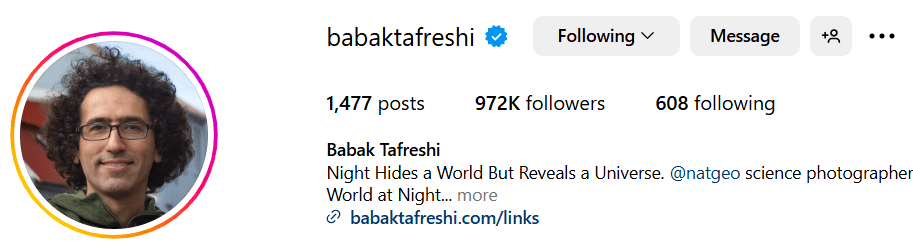
@babaktafreshi | Astrophotography
Babak Tafreshi is a renowned astrophotographer who has spent over 30 years capturing the night sky from all continents. He carved a unique niche by blending Earth’s landmarks with celestial wonders, uniting art and science. He also founded The World at Night (TWAN) project, connecting 40 photographers from 20 countries to promote dark sky preservation and humanity’s bond with the cosmos. Babak’s unwavering focus on his niche have earned him global acclaim and a published book, inspiring countless stargazers and photographers.

Anup J Kat
@anupjkat | Underwater Photography
While Anup is a professional cinematographer and also a wedding photographer, I know him for his outstanding underwater photography, which is a very refined niche. Anup has received many prestigious international awards, including CLIO which he is the only Indian to win. He is also passionate about scuba diving which naturally complements his knack for underwater imagery. But that does not restrict him from film-making.
Ami Vitale
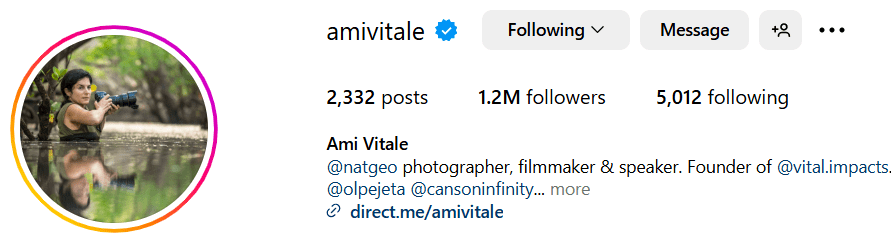
@amivitale | Wildlife & Photojournalism
Ami Vitale is a wildlife photographer who is dedicated to documenting global crises and wildlife conservation. Her stories focus on people facing war crisis, climate change, extinction of species. She has received many international awards including from World Press Photos for five times and published a best-selling book, Panda Love, on the secret lives of pandas. If you think of ‘Ultimate Purpose‘ I mentioned earlier, this is her purpose to serve the world and make it a better place.
1. Still not sure how to go about finding your niche? Download my free worksheet with reflective questions to help you get started!

Conclusion: Your Journey, Your Rules
It’s okay to feel torn between all creative possibilities in front of you. But the good part is – there’s no rush to figure it all out right away. In the end, it all comes down to what truly satisfies your heart and soul. Here’s what I want you to remember: defining your niche isn’t about boxing yourself in. It’s about finding the thing that makes you feel alive and letting that guide your work. Whether you choose to specialize or explore multiple genres, your creative journey is uniquely yours—and there’s no wrong way to approach it.
So, take your time. Experiment. Reflect. And when you’re ready, trust yourself to make the choice that feels right. After all, the best part of being a creative is that you get to write your own rules.
What kind of photography makes your heart race? Have you defined your niche or are you still exploring? Share your thoughts in the comments or tag me (@vivekverma0909) in your posts—I’d love to hear your story!
An ideal niche is not something you choose. It’s something you discover — by serving, and noticing where there is resonance.
Val Nelson

Hey there! 👋
I’m a travel photographer and blogger based Mumbai, India. My passion lies in capturing stunning landscapes, timeless architecture, and the raw beauty of streets. But more than that, I love connecting with fellow photographers—whether it’s to chat about legal hurdles, tackle creative blocks, share a laugh over our struggles, or discuss mental health challenges we face as artists.
If you ever feel like sharing your journey, asking questions, or just need someone to talk to, I’m just a message away! Drop me a line at vivekvermavisuals@gmail.com or find me on Instagram/Threads at @vivekverma0909 and @creativegenesstreets. Let’s navigate this photography adventure together and make it truly unforgettable! 📸✨
Credits & Further Readings
How to find your art niche: The ultimate guide by Serena Archetti
Want to stand out? Do what 90% of people won’t by Roshan Thiran
How to Identify Your Design Niche and Stand Out by Kosmo Team
Finding your niche and brand by Chanelle Garcia
A Step-by-Step Guide to Finding Your Niche in Portrait Photography by Nataliya Lalor
Discover more from Vivek Verma
Subscribe to get the latest posts sent to your email.
 Vivek Verma
One thought on “Should You Focus on One Photography Niche?”