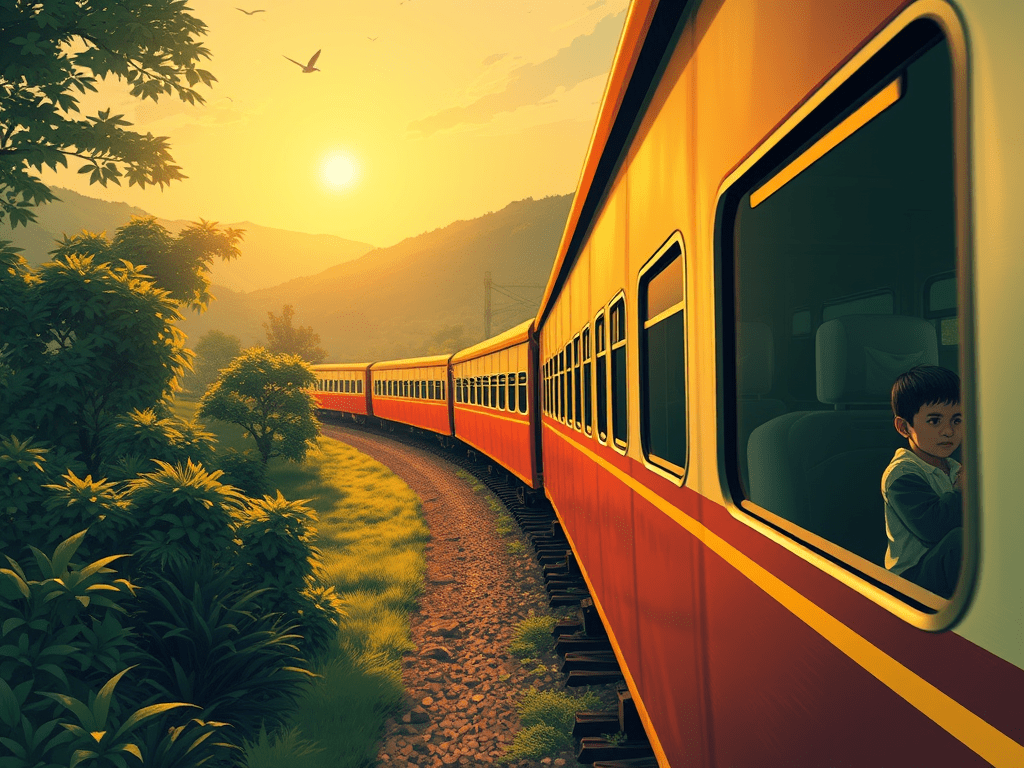
A slow family journey from Mumbai to Mussoorie via Delhi, Rishikesh and Dehradun. Train travel, toddlers, friendships, food and the joy of unhurried miles.
Planning the Trip “with Kids”
Traveling with toddlers changes the grammar of a journey. Distances grow longer, pauses become precious, and the wisest strategy is almost always the simplest one: space it out.
An Unconventional Itinerary
Our road to Mussoorie began, sensibly, in Delhi, allowing us to deboard and take a breathe. From there we moved gradually northward — two unhurried nights in Rishikesh, a gentle halt in Dehradun, and only then the final 1.5 hours drive to the Queen of hills, we call Mussorie. Each stop softened the transition — in altitude, in temperature, in mood. The air sharpened slowly. The woollens emerged without drama.
Breaking the Journey
There is certain dignity in allowing a route to unfold. Breaking the journey also saved us from that peculiar fatigue of modern travel where highways erase the character of the places they connect. Instead of bypassing cities like Delhi, Haridwar, Rishikesh in the hurry to “arrive,” we allowed them to introduce themselves — a riverside evening here, a quiet breakfast there, the sense of moving through a living map, rather than across a checklist.
Timing it Right
We chose early February carefully. Firstly, it was an off-season in Haridwar and Rishikesh, meaning no surging pilgrim crowd at Ganga ghats, no endless queues adding to the chaos of the day. Winter still held the mountains, but with a gentler hand — enough chill to feel romantic, not enough to be freeze small fingers or trigger moods and melt-downs. The occasion, after all, mattered. This was our 6th anniversary, and it demanded memory, not management; presence, not panic. Much like our journey through Kerala the year before, the idea was to celebrate by traveling in a way that creates memories to cherish forever.
By the time we finally curved into Mussoorie, no one felt exhausted by the road. We had eased our way toward it, step by step, arriving not only with body and mind sane, but also open — which, when traveling with young children, may be the finest luxury of all.
Day 1: Catching a Train to Delhi and Why So?
We decided to take the train from Mumbai to Delhi. The longer way. The slower way. The human way.
My Love for Train Journeys
I’ve always loved train journeys. Once the bag disappears under the seat and the platform begins to drift away, something inside you unclenches. The signal weakens, the pings fall silent, and for a few blessed hours the world cannot keep tapping your shoulder. You are carried forward, but freed from the need to respond.
Trains have a way of returning you to earlier selves. Childhood at the window, counting poles. College years with a novel open on your lap, reading a few pages, then gazing outside until the landscape becomes part of the story. You look up, and someone asks what you’re reading. Just like that, a conversation begins.
Connecting Human to Human
You speak to the elderly man across from you and discover a life of risks you never took. A young student tells you why she left home. Someone disagrees with you, gently, and you carry that difference with you long after the train moves on. These exchanges may be small, even accidental, but they widen the world. They remind you that people are deeper than opinions and warmer than their online shadows.
Making Some Space for Boredom
And then comes boredom. At first it irritates, with nothing to scroll, no quick escape. But if you allow it, boredom begins to clear space inside you. Long-delayed thoughts surface. You observe more carefully. You listen better. You become available — to the book in your hand, to the passing fields, to the stranger who might speak.
Letting in Some Randomness
This is where randomness enters. Our days are mostly plotted in advance. Same routes, same feeds, same conclusions. Surprise has been engineered out of daily life, and without surprise we slowly become numb like machines. The train reintroduces chance: who sits beside you, what story you hear, what new local food you may try, which memory returns, what idea arrives while you stare at nothing in particular. Letting randomness in, keeps life interestingly strange. It interrupts certainty. It makes room for wonder.
And when you finally arrive, you realize you have received far more than transport. You have recovered attention, curiosity, and the simple, ancient pleasure of being with other human beings.
The Cost Saving & Comfort
Moreover, the maths frequently works in the train’s favour. Even a berth in a first-class air-conditioned coupe (usually around INR 5000/- per pax) can come in below the price of a flight, yet what you receive in return feels far richer: a private room set gently in motion, meals and tea arriving at your seat, the luxury of settling in with peace.
Travelling with Toddlers – Train vs. Flight
With energetic toddlers, that arrangement becomes less indulgence and more strategy. They can stand, shuffle, explore the narrow kingdom of the compartment, burn off impatience — freedoms unimaginable in an aircraft aisle governed by seat belts and stern glances. Luggage stays where you placed it, doors close, voices soften. For a while, travel begins to resemble living.
Choose a more open class with young children and the equation changes; space tightens, vigilance rises, and rest becomes negotiable. But in a coupe, the journey unfolds with a rare blend of movement, privacy, and ease — a small home rolling steadily toward its destination.
Which Train to Catch from Mumbai: If you’re planning to trade runway rush for the romance of rails, my strongest vote goes to the Mumbai Central–Hazrat Nizamuddin Duronto Express. Running twice a week — Mondays and Fridays — it fits beautifully into a working professional’s calendar. Wrap up your last call, finish dinner at home, and arrive at Mumbai Central railway station in time for the late departure at 23:10. And by mid-afternoon, roughly 16.5 hours later, you roll into Hazrat Nizamuddin railway station at about 4 pm — rested, unhurried, and with an entire evening still in hand.
Packing Note: bring along their favourite toys and go-to snacks — small comforts that keep little hands busy and small stomachs satisfied while the miles roll by.
Day 2: Dil, Dosti and Delhi
We reached Delhi around four in the evening. Instead of a hotel, we drove to a friend’s home, welcoming us for some shared time together. This may often feel unnecessary, especially when we had both lived in this city once. Seen it, done it, outgrown it. But the stop was never about Delhi. It was about something far more precious than travel itself – friendship.
Colleagues or Friends?
Once college recedes in the rear-view mirror and rigours of a job takes over, the countor of friendship alters. A workplace can appear crowded — desks occupied, calendars packed, faces everywhere — yet most relationships remain curiously weightless. Only a handful ever cross that delicate, unseen line from colleague to the sort of person you would still call, still visit, long after the farewell speech is over and the last crumbs of cake have been wiped from the table. It is a difficult alchemy, and increasingly rare.
To hold on to friendships that have survived office exits, relocations, and the many climates of adulthood is a form of quiet, compounding wealth. By that measure, my wife Sonam, is extraordinarily rich — and I admit I look at her fortune with more than a little envy.
Friendship Meets Parenthood
Even if you are fortunate enough to have found a few such friends, the equation shifts the moment children arrive. The day is no longer yours to arrange. It is measured in lunch-box preparations, food spills, school bags, unfinished tasks, and the quiet negotiations required to get everyone to bed — mostly later than you promised yourself. Night offers rest, but rarely restoration, and morning begins before you are ready.
Nothing about the affection fades. If anything, it deepens. What disappears is availability. Weeks blur into months, and friendship survives in warm assurances of “soon,” in birthdays remembered, in photographs liked at odd hours — a long chain of loving postponements that nobody planned, yet everyone understands.
A Comforting Home
So we showed up. Shoes off at the door. Kids slowly warming to unfamiliar rooms. Tea turning into conversation, conversation into memory. Nothing dramatic, nothing grand — just the rare comfort of being together without hurry.
In the demanding mathematics of adult life, where friendship often slides to the margin. That evening nudged it back to the center. When we finally went to bed, it didn’t feel like we had delayed the trip. It felt like we had remembered what travel is really for — the people who make the miles matter.
Reliving the Forgotten Times
The following day we gathered with her old gang in Hauz Khas. Laughter arrived in waves — loud, unembarrassed, almost unfamiliar to ears trained by routine. I slipped away briefly, stealing an hour to stand quietly inside Lalit Kala Akademi, where my absract work hung on their prestigious gallery wall.
That night we moved again, this time to the home of another of friend of hers — someone with whom we had shared the deep, unforgettable beauty of Kashmir a few years ago. Travel binds people quickly; memory keeps them bound. From here, we had a cab pre-booked for Rishikesh, the very next morning.
What if you do not have any such friends in Delhi: If no friend is waiting for you in Delhi, let the city itself host you. Return to a place that you once knew — a familiar crossing, a market corner, a memory you left behind. Travel is sometimes just a quiet reunion with your former self. Or visit a place you never got the chance to visit earlier. Then find something comforting to eat. Chole-kulche, rajma-chawal, or a warm paratha in the lanes of Old Delhi has a way of filling more than just the stomach.
This is only the beginning. In Part 2, the road rises, the air cools, and the plains slowly give way to river towns and mountain bends. We head for Rishikesh, pause in Dehradun, and finally climb into the waiting hills of Mussoorie.
There are stories from the highway, unexpected moments, small victories of traveling with children, and the kind of memories that only reveal themselves when you look back.
Stay with me — the best stretch of this journey is just ahead.
Love
Vivek
Written by Vivek Verma, a travel and landscape photographer whose work sits at the intersection of movement, memory, and place. His photographs have appeared in publications such as Vistara’s in-flight magazine and Deccan Chronicle and various other magazines. Through his platform Creative Genes, he documents journeys that value patience over speed, human connection over checklists, and stories that remain long after the road ends.
Discover more from Creative Genes
Subscribe to get the latest posts sent to your email.
 Creative Genes
One thought on “Mumbai to Mussoorie via Rishikesh – Family Travel Itinerary (Part 1)”