Many first-time artists waste thousands on printing, framing & fake ‘exhibitions.’ This guide shows the real costs in India & how to save smart.
Ask ten photographers in India how they managed to get their work exhibited in a gallery — or how much it actually cost them — and you’ll hear ten different answers. Most are vague, half-true, or evasive. Why? Because not everyone wants to reveal the real numbers or the hard truths behind their “success.”
But here’s where I want to do things differently. I believe in putting the information out there — openly, honestly, and backed by my own lived experience, even though it may not be complete picture. Because if I can save even a few artists from overspending, falling into traps, or walking in blind, it will be worth it.
When I did my second group exhibition in July this year, I was ecstatic to see my work framed and displayed in a prestigious Mumbai gallery. That was just the start. Fast-forward two months: I have more than ten exhibitions to my credit (including upcoming ones). What that journey gave me was not just a bit of recognition — but also a glimpse of how the photography exhibition ecosystem in India really works.
And the numbers? They’re shocking even to me. Who would believe that I’ve spent over ₹70,000 in just the past two months purely on exhibitions?
This post is my attempt to take you behind the curtain. In the sections that follow, I’ll break down:
- The actual costs you may face for printing and exhibiting (no fluff, no hidden extras).
- The smart hacks I wish I knew earlier to cut down expenses.
- The red flags of scams and online traps every photographer should avoid.
If you’re even thinking of exhibiting your work — whether you’re a painter, photographer, or digital artist — this guide may give you the clarity others won’t.
The Bare-bones Cost Heads in India
Group shows in India usually run on a simple model. Forget about insurance, PR teams, or grand launches — that’s rare. What almost every participant pays for is just three major things:
Printing — the Silent Game Changer
On the surface, printing sounds simple. Walk into a local print shop, hand over your file, get a large-format print for a few hundred rupees — done. Right? Wrong.
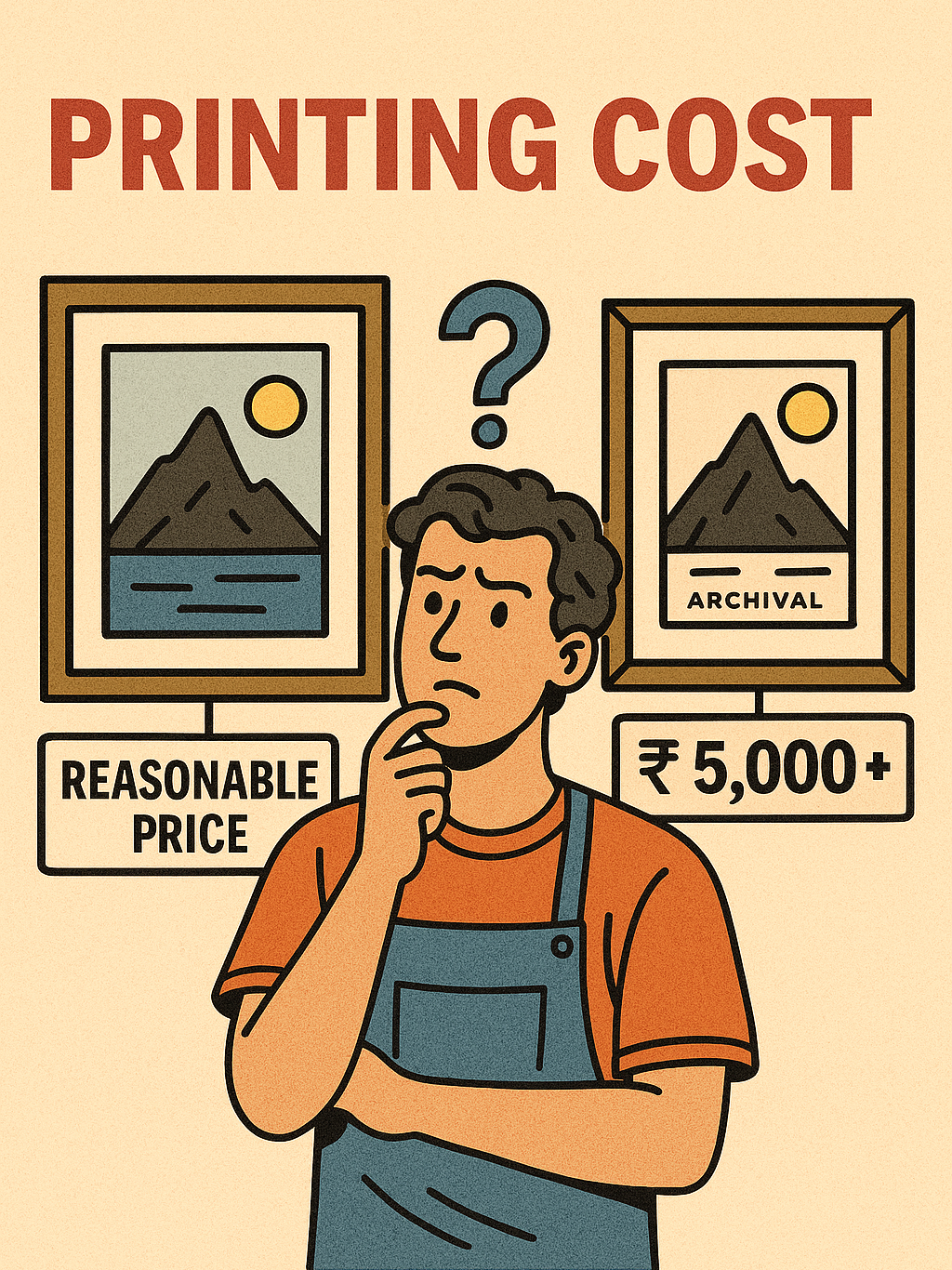
Exhibition printing is a completely different ballgame altogether. This is where the fate of your artwork can rise or collapse. The same image that looks fine on your screen can look dull, flat, or cheap on the wall if it’s not printed the right way.
Here’s the shocker: the cost of an exhibition-grade print can easily shoot up to ₹5,000 or more per piece, depending on the size. Why? Because it’s not just about ink on paper. It’s about:
- Print quality and technology (giclée (acid-free), pigment vs. dye inks)
- Paper choice — matte, glossy, metallic, textured, or fine-art papers that are often imported
- Archival longevity — prints designed to last decades without fading
- Framing style — glass vs acrylic, mounts, float frames, or shadow-box displays
Sounds unusual? It is — but this is what separates a casual print from a museum-quality exhibition piece. Let me give you a glimpse of what I incurred (inclusive of taxes) for my five exhibition prints:
- 24″ x 16″ inches Print on Epson matte paper + 2″ Off White Mount + 0.75″ Wooden textured Box Frame: INR 4800
- 12″ x 18″ inches Print on Epson matte paper + 1.5″ Off White Mount + 0.75″ Wooden Textured Box Frame: INR 2700
- “12 x 18” inches Print on Canson Paper + 1.5″ White Mount + 0.75″ Black Box Frame: INR 3481
- 12″ x 16″ inches Print on Hahnemuhle Canvas + Gallery Wrap: INR 3200
- 9″ x 12″ inches Print on Canvas paper + 1″ Black Mount + 0.75″ White Box Frame: INR 2250
In case you’re curious about where I usually get my prints done — I’ve often relied on Photostop by Honeycomb for fine art printing. Over time, I’ve found their quality consistent, the variety of papers and finishes wide enough to suit different projects. Most importantly, their staffs are very approachable and cooperative, which makes the entire process smoother.
Watch this space — I’m putting together a series of deep-dive articles on the fascinating world of fine art printing. From cutting-edge technologies to the secret lives of papers and finishes, you’ll discover exactly what separates an ordinary print from a gallery-worthy masterpiece. The next time you walk into a print shop, you won’t just hand over your files — you’ll know exactly what to ask for, and why. In the meanwhile, find some interesting articles on our Resource page here.
Exhibition Fee — Cost of Opportunity or Cause for Concern?
One of the most debated aspects of exhibiting in India is the exhibition fee. Depending on the organiser, this may include printing and framing, or simply the rental of a certain section of the gallery. At first glance, the variation in fees can feel confusing, even unfair. But if you look closer, there are reasons behind these differences.
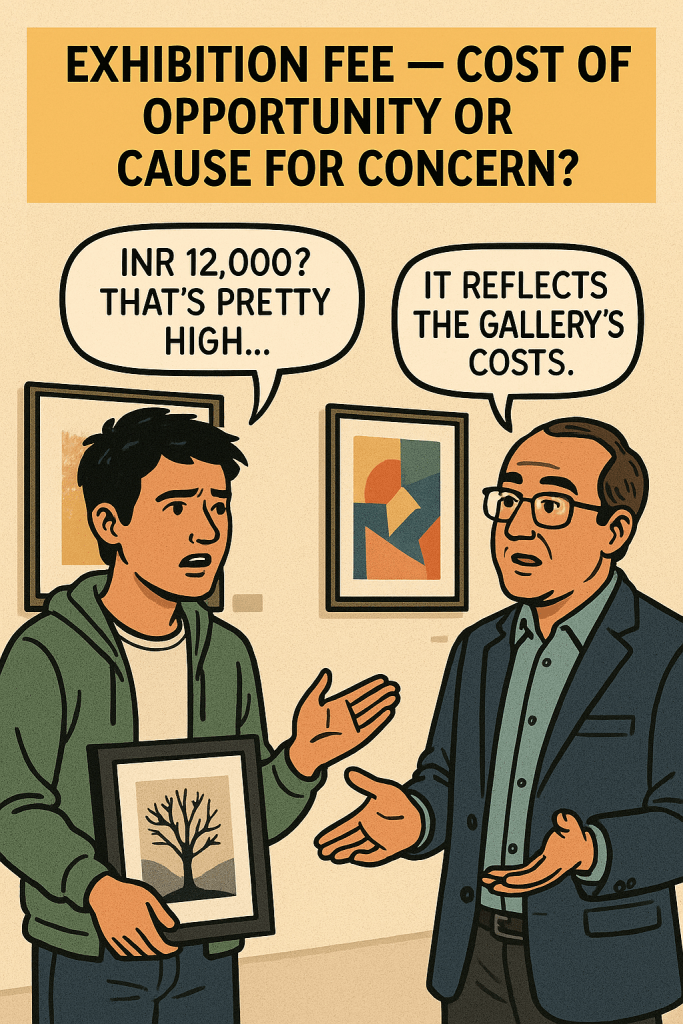
From my own modest journey, here are a few examples. But in these examples, I am referring specifically to open-call opportunities for emerging artists; established names in the art industry are often directly invited by galleries or curators and typically do not bear any such participation costs.
The most affordable fee I’ve paid so far was INR 1,400 per artwork, upon selection by a well-known photography festival being hosted by COG India in Kolkata this December. The amount covered printing, framing, and display. For me, it was one of the best value-for-money experiences: no transit cost, no risk of damage, and no hidden extras. However, the flip side was – I had no visibility or say on the print and frame quality. At a few other exhibitions—in Mumbai and Pune organised by Bangiya Kala Kendra and CreARTors Collective—I paid INR 1,500 per artwork upon selection of my work. This fee didn’t include printing and framing, giving me the freedom to choose the finest quality printing for my work.
Just last month, I paid INR 3,000 for a single artwork, after being selected by a curator for display at a small art gallery tucked inside a residential building in Mumbai. The space was modest, but the gallery had a recognised name and a 16-days’ show duration — factors that justified the fee.
At the other end of the spectrum, another curator/organiser selected two of my abstract work for exhibition at Lalit Kala Akademi in Delhi for INR 12,000. At first glance, this seems steep, but the gallery’s profile, central location, and credibility with collectors carry a certain premium.
- Tier-I range: INR 1500-2500 per artwork
- Tier-II range: INR 3000-6000 per artwork
- Tier-III range: INR 6000 and above per artwork
Needless to say, all prices mentioned in this article are purely for reference only, based on my personal experiences. They are not intended to represent the entire industry or to suggest a universal standard. Actual costs can and do vary significantly depending on multiple factors — including the reputation of the artist, the gallery, the curator, the location, size of the artwork and the nature of the exhibition.
Why such variation? Part of it comes down to venue rentals, curation, location, and duration. A central gallery in Delhi or Mumbai has drastically different overheads compared to an artist-run space in a smaller city or suburbs. Exhibition fees for group shows—typically falling under the ‘commercial’ category—are usually much higher when charged by the gallery owner to the organizer, compared to non-commercial exhibitions. Organisers may also factor in branding, marketing, and the prestige attached to the venue. The cost of hosting a solo exhibition can skyrocket—often touching a staggering INR 1 lakh and above.
Let’s be honest—I’m not exactly the hotshot artist galleries would run after to exhibit for free. So, until that that fantasy day arrives, I’m the proud sponsor of my own shows. What matters is whether the visibility, credibility, and potential sales from the show justify the amount you’re paying.
Stay tuned — because in my upcoming posts, I’ll reveal the key sources of these opportunities and show you how to tap into them smartly, turning each exhibition into not just a showcase, but a milestone in your artistic journey.
The Hidden Cost of Transit and the Risk of Damage
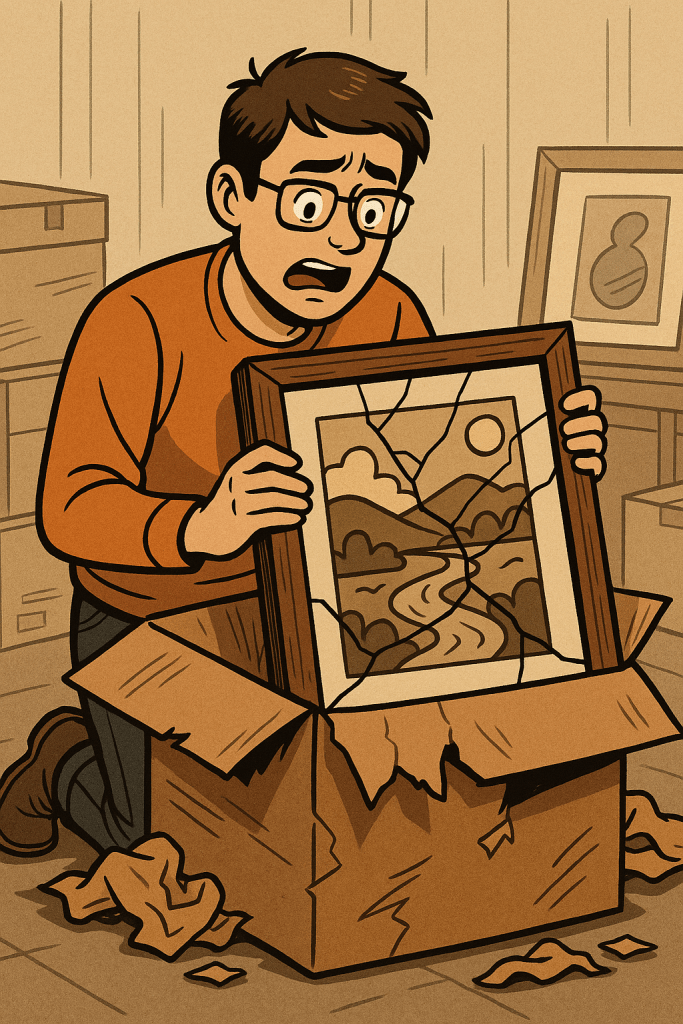
Packaging and transit are among the most underestimated expenses for artists — until they strike hard. It isn’t just about courier fees; it carries the hidden cost of potential damage, delays, and replacements — sometimes even the priceless loss of your creation itself.
To give you a general sense, courier charges in India can range anywhere from INR 300–400 per Kg with regular service providers to INR 1,000–2,000 per Kg with premium ones (like BluDart). Add packaging to this, and the numbers climb further.
And remember, transit costs also vary by mode of transport: air freight can easily be up to twice the price of surface shipping, and rates aren’t uniform across pincodes in India.
- Local transit (surface): INR 500–1000 for one artwork.
- Intercity courier (surface): INR 2,000–5,000+ (depending on frame size/weight/pincode)
- International transit (e.g., India to London): INR 10,000 (for approx 3×4 feet painting)
Couriers may promise “safe art packaging,” but the reality is not always as reliable.
In one of my exhibitions, despite all assurances, my framed artwork arrived with four major cracks on all sides — just a day before the show opened. My brother had to scramble for a last-minute fix (yes, with an ugly brown tape), and beyond the cost, it was the stress and risk of rejection that weighed heavier.
And if your work happens to be an original painting or sculpture, the stakes are even higher. Damage doesn’t just mean repair costs — it could mean the irreversible loss of value of the artwork itself, something no refund or insurance claim can truly compensate for.
What I’ve learned hard way is this: while basic bubble-wrap packaging feels cost-effective and safe, it rarely provides the level of protection needed for framed artworks. Professional packaging — for instance, using 5-ply corrugated sheets — offers much better security. However, when such packaging is used by courier company, it shoots the cost even further as it comes at much higher price.
Cost-saving Hacks (the Real Survival Kit for Artists)
Exhibiting is rewarding, but it doesn’t have to burn your savings. Here are my own tested ways to cut costs smartly, without compromising the impact of your work:
1. Reduce the number of submissions
Don’t feel pressured to submit many works unless it’s a sales-driven show. A strong single piece can often speak louder than three. For portfolio-building, quality trumps quantity. Now I submit only one image per exhibition to add it to my artist portfolio/resume.
2. Recycle artwork across exhibitions
You don’t need fresh prints for every group show. The same framed work can be reused in multiple exhibitions — simply tweak your artist statement slightly to match the new theme (without compromising on the essenece) and use a more standard size to fit maximum size requirement. This way, I have recycled the same printed work for multiple exhibitions.
3. Local printing & framing for outstation shows
Instead of paying heavy courier fees to ship from your city, coordinate with a trusted print/framing studio near the exhibition venue. You’ll save money and avoid damage in transit. I did the same for my exhibiton in Delhi, saving on the courier cost and avoiding in-transit damage.
4. Price to sell (recover your costs on-site)
Keep your artwork prices reasonable so they’re more likely to sell during the exhibition itself (without undercutting your asking price). If a piece sells, you recover printing & framing costs and avoid the return courier altogether.
5. Exhibit smaller works
12×18 inch or 16×20 inch prints are far more cost-effective to print, frame, and ship. They also sell more easily than oversized works and can be recycled for exhibitions with size limitations.
6. Use ready-made frames
Standard Ikea/HomeTown/online frames with clean mounts look professional and cost a fraction of custom framing. For portfolio shows, this is often enough.
7. Pool resources with fellow artists
Print and frame together, or send works in one courier package. Shared costs (especially for intercity courier) make a huge difference and open possibility for to negotiate the price for a larger order.
8. Hand-deliver when possible
If the exhibition is within your city (or within driving range), deliver your work yourself. Saves transit fees and reduces the risk of damage.
9. Track your costs vs. Exposure
Not every exhibition gives the same value. If an exhibition charges a high wall fee but offers no visibility or sales prospects, it might be better to skip and invest that money in a stronger show.
10. Sell the work on Art websites, post exhibition
List unsold works on reputable art websites post-exhibition — this way you not only extend their life beyond the gallery wall but also recover costs without risking another round of shipping damage.
11. Beware of Virtual Exhibitions
Many organisers advertise online exhibitions — basically putting your work on Instagram or a website. They often charge you but don’t carry the weight of a real, curated, physical exhibition. For your CV and growth, only count curated physical shows or serious curator-backed virtual exhibitions as exhibitions.
Conclusion — Clarity Before Commitment
Exhibiting your work in India is an incredible experience — but it comes with real costs that every artist should prepare for. From printing and framing to wall space fees and the hidden risks of transit, every single buck counts. We also saw how fees can vary across low, mid, and high tiers, why it’s important to weigh value against cost, and the practical hacks — from reusing artworks to local framing and even selling works online — that can make exhibitions more affordable and sustainable.
The key takeaway is this: exhibiting is rarely free unless you’re already a well-known name in the industry — but it doesn’t have to be wasteful. With the right planning, awareness, and cost-saving strategies, you can turn each exhibition into not just a proud moment but also a smart investment in your artistic journey.
If you’re planning to exhibit soon, here’s my final piece of advice: don’t go in blind. Look out for genuine, well-curated, and value-for-money opportunities — the kind that add credibility to your CV without draining your pocket.
Now I’d love to hear from you — what has your own experience been with exhibition costs in India? Have you faced challenges with printing, framing, fees, or transit? Or do you have tips and hacks that could help fellow artists?
Share your thoughts, questions, or stories in the comments below. Let’s build a community where artists and photographers can learn from each other’s journeys.
Useful Resources: Printing Rate Card | A Background on Color Perception | Understanding Bit Depth | Digital Pixels: PPI, Dithering & Print Size | sRGB vs. Adobe RGB Colours | 8 Crucial Steps to Prepare Images for Printing | 5 Tips for Printing Your Photos | How to Print and Frame Photos | Glossary of Printing Materials
Discover more from Vivek Verma
Subscribe to get the latest posts sent to your email.
 Vivek Verma
One thought on “How Much Does It Cost to Exhibit Your Artwork in India? A Complete Guide for Artists & Photographers”