
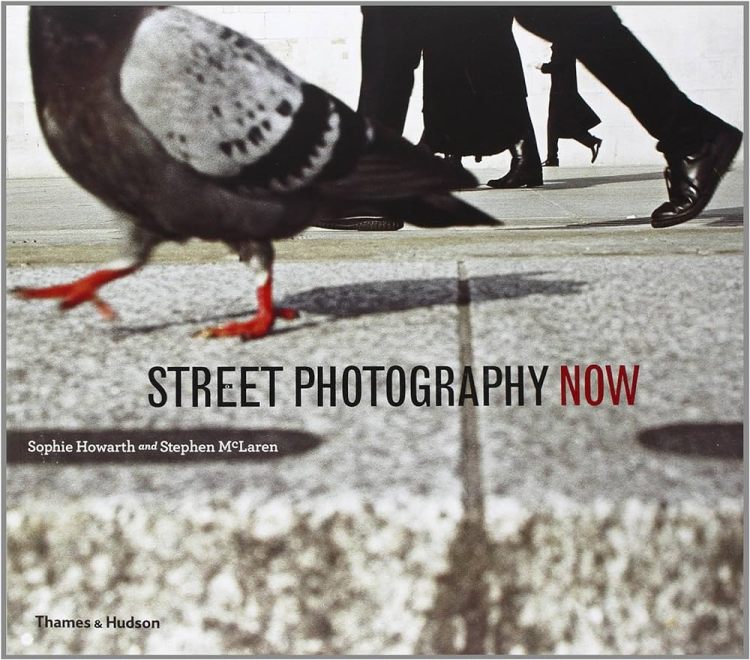
Street Photography Now by Sophie Howarth and Stephen Mclaren was my second book on street photography. The book, at once, seemed too big for me to finish, but it was not at all text heavy.
Firstly, it is not a book on “how to do street photography” and assumes prior knowledge of the subject. It is rather a book of ideas, thoughts and pictures from contemporary street photographers to help you delve deeper into street photography as a genre. The book claims that it is the first ever comprehensive examination of international street photography since the late 1980s. However, what makes this book stand out among many other books on street photography is that it features 46 awesome image-makers capturing life in streets, subways, malls, theaters, beaches, and parks, and provides you a scoop on their creative vibes with fun essays and quotes that spill the beans on their influences. Legends like Bruce Gilden, Martin Parr, and Alex Webb join fresh talents, giving you a snapshot of epic moments in cities like New York, Paris, London, Istanbul, Dhaka, Delhi, Dubai, and Dakar. In nut shell, this book helps you see what other renowned street photographers are doing around the globe and their thoughts, inspiration and influences behind their creation.
The book is divided into five sections, namely:
1. Stare, Pry, Listen, Eavesdrop
2. No Ideas but in Things
3. Half of the World’s Population Now Lives in Cities
4. Some Truths Cannot be Told Except as Fiction
5. Street Photography Now: A Global Conversation
1. Stare, Pry, Listen, Eavesdrop
This section covers what makes a street photograph extraordinary. The section also touches upon the issues of photographic liberty and liabilities, for street photographers and their challenges.
What I liked about (or learned from) the featured photographers
Arif Asci | Turkey
His creative use of the vertical format to emphasize narrow crammed spaces, opened up my mind to look beyond conventional aspect ratios, and consider tighter aspect ratios like 16:9 (or 9:16) and panorama. Arif sees street as endless possibilities from landscape to abstract. In his words:
‘Everything I need is in the street. I can create a beautiful landscape, a social drama, or a very personal, almost abstract photograph.’
Bang Byoung-Sang | South korea
I liked how she treats her street photography more as “time” for herself to watch and observe the world around her. It reminded me of the famous poem ‘Leisure’ by William Henry Davies which goes like-
“What is this life if, full of care,
We have no time to stand and stare.“
Her piece of advice – “Photography should never ruin a real-life moment.”
Bruce Gilden | new york
I liked how Bruce excels in showing slices of life that in several years won’t be there, and loves to capture people with certain individuality in the way they dress or look, when rest of the world is tending to look or dress more alike. Bruce insists on creating certain mystery element in the photographs so as to not reveal every secret of the human psyche. He says- ‘If you can smell the street by looking at the photo, it’s a street photograph.‘
Christophe Agou | france
Christophe uses photography “to hint at the depth of what it is to be human but never to simplify.” His photography series, “Life Below” based on New York subway, inspired me to look for similar possibilities in India.
Narelle Autio | australia
One key takeaway I derived from her work was to consider my own country India itself as a limitless possibility, and capture things I have grown up with, places I have lived in, social issues I care about, and things I have been taking for granted all these years.
‘Stare. It is the way to educate your eye, and more. Stare, pry, listen, eavesdrop. Die knowing something. You are not here long.’
– Walker Evans,
Personal Notes (what I learnt)
- Street photography thrives on the “unexpected”.
- A great street photograph must elicit more than a quick glance and moment of recognition from the viewer. A sense of mystery and intrigue should remain, and what is withheld is often as important as what is revealed.
- Learn to find gold in even potentially uninspiring subjects and apparently meagre visual possibilities.
- Street photography might appear easy, and sometimes an amateur gets a fantastic shot by luck. Yet, photographers who regularly create captivating, well-structured street photos don’t rely on luck.
- As per Elliott Erwitt, “Photography has little to do with things you see and everything to do with the way you see them.”
Carolyn Drake | Los angeles
Carolyn believes in breaking stereotypes that photographs can often perpetuate.
Melanie Einzig | los angeles
She sees the world never short of richness and promise, despite its flaws and absurdities. My key learning from her was that you need not go out specifically to shoot street photographs. She says, her best photographs were taken going to or from work, or some other destination, using simple intuition.
What to look for?
Visual pun, street signs, advertisements, graffiti, gestures, reflections, something unstable or limping, fabrics, unlikely patterns, collisions of line and form, small details that can reveal the bigger picture.
2. No Ideas, but in Things
This section is about still life street photography and breaks the common myth that a street photograph always has to have people or street in it.
What I liked about (or learned from) the featured photographers
JENS OLOF LASTHEIN | SWEDEN
Jens is a proponent of long-term projects and prefer to work slowly so as to reflect and let things change along the way.
‘The pictures I am most satisfied with are those where it’s not possible it determine where and under what circumstances they were made. Because, that’s when the mind will start wandering, finding its own interpretations.’
MARKUS HARTEL | GERMANY
Markus says, street photographer deserves a break to look at things from a fresh perspective. He assures that a photograph need not always be pretty if it is able to show beautiful moments. His piece of advice-
‘The photographer need to be pretty ballsy, or simply quicker than the subject.‘
RICHARD WENTWORTH | UNITED KINGDOM
Richard has an eye for finding meaning in the ordinary things abandoned or redeployed in unexpected ways or nearing the end of their usefulness.
‘Go slowly, wait, look closely and take pleasure in the small, unexpected things.‘
Personal Notes
- Street photographs need not necessary have people in it. It can also be about evidence of human presence and tangible things.
- Objects photographed in public places must also factor in what else is around to give context.
THIERRY GIRARD | FRANCE
Thierry’s process of discovery has been more of a personal journey and ‘an intellectual and a physical confrontation with ordinary life’. He loves to capture the simple reality of things, with both distance and empathy.
Virtues of Street Photographers
An eye for detail, being constantly in a look out for the unreal moment in the everyday, out-of-ordinary within ordinary, patient, optimistic.
3. Half of the World’s Population Now Lives in Cities
The third section of the book talks about how it is like to shoot streets in cities like Paris, New York, London, Istanbul, Dubai, Shanghai and Shenzhen with reference to the work of popular street photographer from these cities. While for many of them their hometowns have been key source of inspiration, it also acknowledges being an outsider in a city enables one to look at it with fresh eyes.
What I liked about (or learned from) the featured photographers
TRENT PARKE | australia & Boris Savelev | UKRAINE
They both romanticize about light. Trent says he is forever chasing light as it turns the ordinary into the magical. Boris considers light as the great magician, which in a second can transform the trivial into the extraordinary. I loved how Boris’ work compels a viewer to concentrate on the various elements within the frame, linked in a mysterious set of relationships that defy easy reading.
Joel Meyerowitz | new york
Joel sees street photography as a personal journey, and insists that every photographer needs to do it for themselves. He says, ‘It’s a way of discovering what the world looks like and no one can do that for you.’
‘I believe that the photographer’s job is to cut a frame-sized slice out of the world around him, so faithfully and honestly that if he were to put it back, life and the world would begin to move again without a stumble.’
Raghu Rai | India
Personal Notes
- Being a habitual walker and always alert for incidental drama or absurdities, however small or insignificant, has been one of the key traits of many street photographers.
- You need not be anywhere special to take strong street photos. You can find photographic gold wherever you belong.
GUS POWELL | NEW YORK
Gus thrives on his readiness for decisive moments that have a subtle comedy or tragedy to them. For him, it is when one sort of moment rubs against another, a photograph becomes most moving and satisfying.
MARK ALOR POWELL | USA
Mark finds it important to be in the right mood to receive a photograph.
4. Some Truths Cannot be Told Except as Fiction
This part of the book debates the veracity of street photographs that are not truly candid and often staged, posed, recreated, or set-up to create a fiction out of reality. It also questions whether even an unposed candid photograph, once captured, is still a reality, citing works of photographers which make a persuasive case for the argument that some truths are best told as fiction.
What I liked about (or learned from) the featured photographers
MATT STUART | LONDON
Matt’s panache at giving his photographs a comedic turn.
ALEXEY TITARENKO | ST PETERSBURG
I liked how Alexey uses long exposure to create obscurity and human fragility in his street photos.
LARS TUNBJORK | SWEDEN
Lars uses his camera as an entry pass to develop a more intimate and sustained relationship with the people he photographs.
AMANI WILLETT | NEW YORK
Amani believes that most of the best images are ones that can never be re-created. He says, ‘People often perceive identical situations in astonishingly different ways.‘ He believes, the best images ask more questions than they answer and finds himself more attracted to images that one can look at over and over gain and each time get something new, something fresh. His thoughts align with that of Trent Parke who says – ‘My photographs are more questions than answers. I use photography as a way to help me understand why I am here. The camera helps me to see.’
‘At a time when staged narratives and rendered images are popular, I am excited by the fact that life itself offers situations far more strange and beautiful than anything I could set up.’
– Melanie Einzig
Personal Notes
- Personal pictures do not have to “do” anything or need to be easily categorized. They are just pictures about life. (Nick Turpin)
- Something special in everyday life exists all around you. You just have to look differently. (Munem Wasif)
WOLFGANG ZURBORN | GERMANY
I liked Zurborn’s love for abstraction, with signs, material, surfaces, colors, and lines often enigmatically layered in his composition. He prefers wide angle lens to create layering and dissolve any kind of depth of filed into a series of surface patterns. Zurborn insists on preserving a sense of ambiguity in the photographs.
YING TANG | SHANGHAI
She considers her photography as a personal journey to be out there on the street, and loves to catch moments that mean something to her, that shows her own point of view.
5. Street Photography Now: A Global Conversation
In this lively section, seven renowned street photographers—Frederic Lezmi, Jesse Marlow, Mark Alor Powell, Gus Powell, Paul Russell, Ying Tang, and Nick Turpin—engage in a spirited intellectual discussion spanning four pages. They explore the essence of a great street photograph, the distinctions between street photographers and photojournalists, and what it means for them to be a street photographer at a personal level. Nick says the greatest challenge in street photography is making extraordinary pictures with often a small camera on an ordinary city pavement without filters, fancy lenses, lights, or models, giving a photographer nothing to hide behind. The section also addresses concerns about the vanishing photographic freedom in public spaces globally and concludes with a debate on the validity of digitally manipulated street photographs.
Parts I liked from this discussion
Being a full-time lawyer myself , I was able to immediately relate when Gus Powell said-
‘Being forced to work in the limited time and space that was available to me while having a full-time job encouraged me to see the merit and surprises in less and less of an event.’
Gus Powell
I also liked the way Frederic distils objectivity from the subjective elements of his photographs, by leaving his pictures to rest for a couple of months and just concentrate on shooting, while travelling.
‘While travelling the only thing I do is make photographs. Nothing else, no emails, no editing and definitely no looking at what I have shot already. I find this important, because it keeps me hungry. When I come home I like to leave the pictures to rest for a couple of months, for the subjective memories to fade away and allow space for an objective judgment of each image.’
Frederic Lezmi
Personal Notes
- A good street photo is ‘tough to like, tough to see, tough to make, tough to understand‘. (Joel Meyerowitz)
- ‘A good street photograph should tease, puzzle, reveal, stun, provoke, and thrill in equal measure. They should be light in mood but dense in emotion, hard to read but easy to enjoy.’ (Stephen McLaren)
- Unlike photojournalists, street photographers don’t necessarily have a theme to start with, or an agenda for taking pictures. While a photojournalist seeks to answer questions of Who, What, When, Where and Why, a street photographer is interested in creating more questions.
Bryan Peterson’s Understanding Street Photography: Book Review & Notes
My Street Photography Portfolio
Discover more from Vivek Verma
Subscribe to get the latest posts sent to your email.
 Vivek Verma
3 thoughts on “Street Photography Now: Book Review & Notes”